How to Write Team Working Agreements That Don't Become Posters
Working agreements get written one of two ways. Both break. Here is a third.
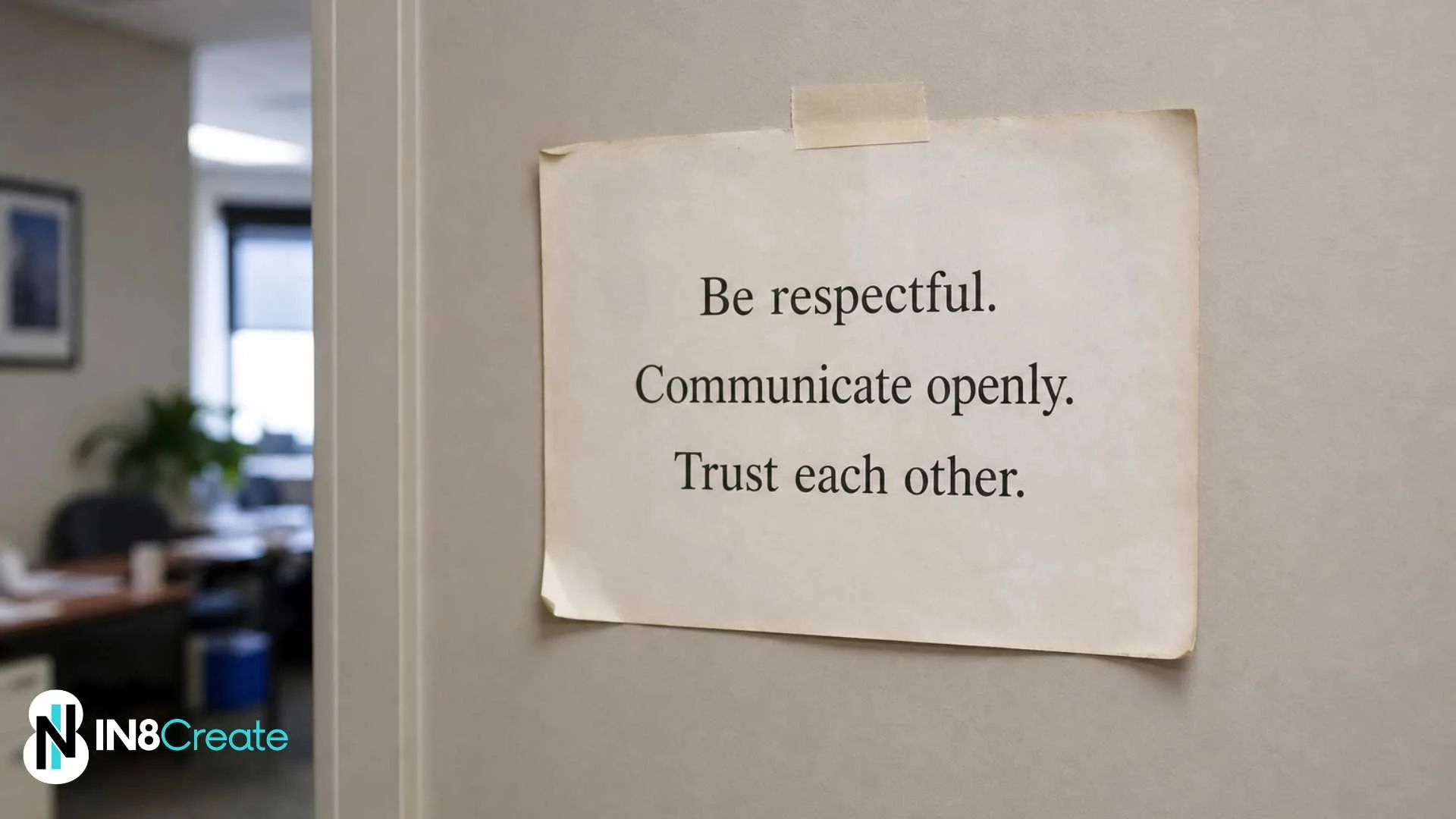
What looks like a working agreement is actually a wish list. Once principles get written without a shared team definition of what they mean, they age into wallpaper.
Working agreements fail for a lot of reasons. People stop paying attention. The team changes. Nobody enforces them. Leadership moves on. Most of those are problems for after the agreement exists.
The most preventable failure happens earlier than that. It happens in the writing. Get the writing wrong and the agreement was dead before anyone had a chance to ignore it.
Most working agreements get written one of two ways. Both ways break. There is a third way that holds up, and most teams have never tried it.
The Two Ways Working Agreements Die
The first version is too specific.
If a deadline slips, escalate within 24 hours.If feedback is negative, deliver it in writing with the manager copied.If a meeting runs over, the next person on the agenda gets cut.
These look responsible. They feel like progress. And they only cover situations the writer thought of. The moment something happens that does not fit, the rule gets ignored, gets bent, or gets a sub-rule added underneath it. The document grows. People stop reading it. The team is back where it started, except now there is a fourteen-page artifact in Notion that nobody respects.
The second version overcorrects.
Be respectful.Communicate openly.Trust each other.
You cannot argue with any of these. You also cannot use them. When a real situation lands and someone has to make a call, "be respectful" tells them nothing. It is a wish written down. Wishes are not working agreements.
This is the dead zone most teams land in. They sense rules are too rigid, swing toward principles, and end up with a poster instead of an agreement.
What Pi Has That Your Agreements Don't
Borrow this from physics for a second. Pi is a constant. It is the same number for every circle that has ever existed. The circles change. The relationship does not.
That is what a working agreement is supposed to do. The principle stays stable. The definition flexes around it.
Here is what that looks like out in the wild.
Principle: We respect each other's time. What that means for us right now: Docs shared the day before. Questions written in line. Status updates posted async, not in meetings.
Principle: We assume good intent before escalating. What that means for us right now: If someone is quiet on Slack for half a day, we DM them directly. We do not loop in their manager until we have actually asked.
Principle: Decisions live closest to the people doing the work. What that means for us right now: Engineering decides architecture. Product decides scope. Leadership decides budget. Disputes get one hour, not a three-week thread.
The principle is permanent. The definition belongs to this team, this quarter. New people join, the tools change, the work changes, and the definition catches up. The principle holds.
Agreements Are a Practice, Not a Document
This is where most teams go wrong twice over.
They treat the agreement like something you write once and post on the wiki. Set and forget. But the agreement is not the document. The agreement is what happens when the team builds it together, argues about what "prepared" means or what "good intent" looks like in their world, and lands on a shared answer. That argument is the work. The output of the argument is the constant.
Then you revisit. Quarterly is a fine cadence. Often it is one short conversation that sharpens what a word means. When we say async, do we mean Slack, or do we mean the doc? Five minutes of clarity saving twenty hours of friction.
If the team did not build it, they do not own it. If nobody revisits it, it goes stale. Either way you are back to a wiki page nobody reads.
A Gut Check
The next time a situation lands that the agreement did not predict, ask the agreement what to do. If it offers you a principle you can apply, with a shared definition the team built, you have a constant. If you find yourself writing a new bullet, you had a rule. If everyone shrugs, you had a poster.
The third path is the one that lasts. And it lasts because the team built it, and because they keep building it.
Helping teams build their Core Constants is half of what I do at IN8 Create. We build them in a session, with hands and bricks, not on a wiki page nobody reads. Get in touch.
