

Same word, two meanings. Why teams walk out of meetings aligned and still stall.
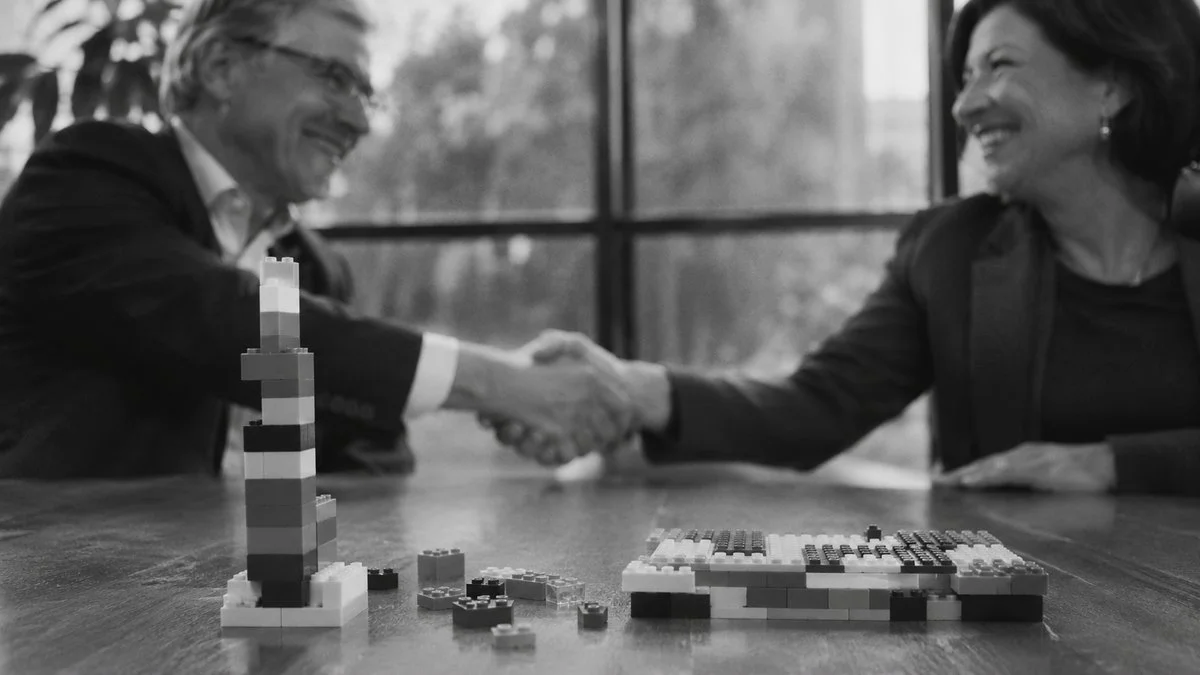
The handshake says you agree. The models say you built two different things.
If you've ever tried dating in New York City, you already know "let's just be friends" is the Swiss Army knife of emotional evasiveness.
Most of the time it's a polite way of saying "I'd rather drink hot dog water than see you again." Every once in a while, though, you meet someone who actually means it. (Which is almost more disorienting. You brace for the letdown and suddenly you have a new buddy who wants dim sum in Chinatown on Sunday.)
Same four words. Two opposite meanings, depending on who's talking.
One person means Sunday bagels. The other means witness protection.
Once you notice it, it's everywhere. "We should definitely get coffee sometime" usually means goodbye forever. A friend who's "five minutes away" just stepped into the shower.
Work runs on the same thing. A leader and a team use the same word, mean two different things, and walk out of the meeting sure they agree. Nobody's being malicious. I call it a semantic miss.
What is a semantic miss?
A semantic miss happens when two people use the same word or phrase to mean two different things. They nod, shake hands, and walk away sure they're aligned.
Then the work starts, expectations collide, and everyone's annoyed.
Inside organizations, we tend to read these breakdowns as personality clashes, politics, or someone dropping the ball. Leaders think an employee missed the mark. Employees think they're being micromanaged.
Usually nobody acted in bad faith. The friction was baked into the agreement from minute one, because nobody stopped to define the terms.
Where semantic misses show up at work
Once you start spotting them, you see them everywhere.
"Take ownership of this"
A leader hands off an initiative and says, "Take total ownership of this."
The project manager hears, "You can make the strategy calls, set the budget, and drive it."
The leader meant, "Do the heavy lifting, but check with me before you decide anything."
Three weeks in, the leader wonders why the PM overstepped. The PM wonders why every move gets second-guessed. Trust erodes, and capability has nothing to do with it. "Ownership" had two working definitions.
"Accountability" doing three jobs
I watched an executive team deadlock for months. One leader kept talking about empowerment while his peers demanded accountability. On the surface it looked like a fight over values. Underneath, "accountability" was quietly covering three different jobs.
Who makes the final call
Who breaks the tie when cross-functional leads are stuck
Who gets the right people in the room
Pack three roles into one word and every decision turns into a turf war. Everyone leaves the room sure the other department is just being difficult.
They never pulled those three jobs apart. Who owned what kept swirling, meetings dead-ended, and the same pressure showed up week after week. It never got fixed.
Everyday workplace words
When a manager says "urgent," they sometimes mean "I remembered this five minutes ago and felt a spike of anxiety." The team hears "cancel dinner and fix this tonight."
A "quick sync" to the sender means "I didn't make an agenda and I need 45 minutes of your brain." The person on the other end expects a five-minute check-in.
When executives ask for "alignment," they often mean "promise me this won't blow up." The room hears "nod politely so we can break for lunch."
The costliest miss is the problem itself
Buzzwords are the small stuff. The expensive misses happen around the actual business problem a team is trying to solve.
Two senior leaders spend three hours agreeing they urgently need to "fix customer retention."
Leader A is thinking about support response times. Leader B is thinking about pricing and contract structure.
They leave energized, launch two competing roadmaps, and spend the next two quarters wondering why cross-functional execution stalled.
What looked like an execution problem started as a definition problem in that first meeting.
How to stop a semantic miss before it starts
Slow down.
When a phrase gets nods a little too fast, pause. The conversation feels comfortable, and that's the moment to ask the slightly awkward question.
"When you say that, what does it look like in practice?"
Define the terms while everyone's still smiling. It's ten times harder once expectations have already crashed into each other.
Making the invisible visible
Words are slippery. It's easy to nod at a buzzword in a conference room and assume your definition is the only one in the room.
That's why I put LEGO bricks in front of leadership teams at IN8 Create.
When people build what "accountability" or "ownership" looks like in three dimensions, the jargon falls away. You can't hide behind a buzzword when you have to explain the model sitting on the table in front of you. The different definitions end up side by side, and the team can sort them out before they cost a quarter.
Asking the question out loud helps. But a spoken answer can stay vague, and people still nod. A model can't stay vague. Five leaders build five versions of "ownership," and the gap is sitting on the table where everyone can point at it.
If your team agrees in meetings but struggles to move work forward, let's look at what's actually being said. Grab a time here.
