Why Your AI Pilots Keep Stalling and What to Build Instead
Louie Celiberti on the architecture-first approach that turns AI experiments into enterprise capability
Being quick is great. Being deliberate and methodical is even better — and none of those things are slow.
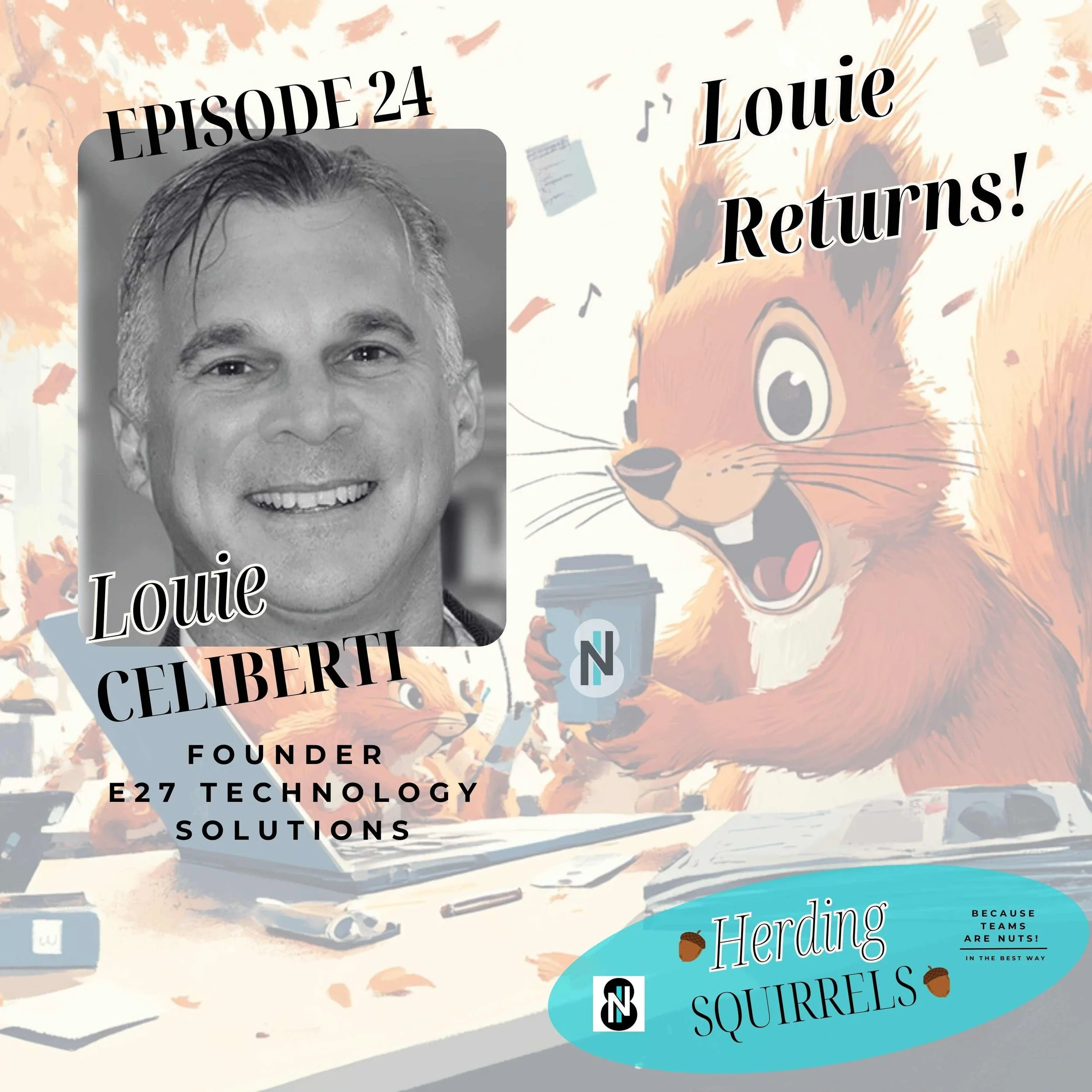
Louie Celiberti is the founder of E27 Technology Solutions and spent over 15 years at Guggenheim Partners leading enterprise data and AI transformation at scale. In this episode of Herding Squirrels, he returns to share why most AI pilots fail not because of the technology but because of how organizations approach the work — and what a more deliberate, architecture-first model actually looks like. If your team is drowning in AI experiments that never seem to graduate into something real, this conversation will give you a clearer picture of what's getting in the way and how to fix it.
About Louie
Louie Celiberti is the founder of E27 Technology Solutions and former Managing Director and Head of Software and Data Engineering at Guggenheim Partners, where he spent over 15 years leading enterprise data, cloud, and digital transformations. He focuses on helping organizations move beyond AI pilots through a pragmatic, architecture-first approach that balances immediate business value with long-term scalability. His work centers on designing modular, vendor-agnostic platforms and investment-optimized roadmaps that allow organizations to reuse capabilities and evolve their AI and data strategy over time.
Find Louie online: e27technologysolutions.io
Episode Highlights
[00:01:00] The CTO shift from driver of innovation to shepherd of innovation
[00:03:25] What engineering discipline gives technologists that most business teams still lack
[00:08:13] The mutual mentorship model and why it makes cross-functional AI work stick
[00:12:00] Slowing down to speed up: the thin-slice approach to AI implementation
[00:18:06] Meeting people where they are: how emotional intelligence shapes AI adoption in resistant organizations
[00:21:12] Why collaboration isn't optional when AI moves this fast
[00:23:45] The real reason AI pilots stall: hubris, missing context, and skipping the ecosystem
Key Insights
The shepherd shift: The CTO role is no longer about generating innovation from the top — it is about harnessing innovation that now originates in the business. The business has always had the context. Engineers bring the discipline to make it scalable and sustainable. (00:01:00)
Engineering discipline is a cross-functional muscle: Technologists have spent decades sitting across every business unit, learning to see how things connect. That pattern recognition — the ability to spot reusability, shared risk, and downstream impact — is something most business teams have never been forced to develop. (00:03:25)
Mutual mentorship as the change mechanism: When everyone gets a turn to share what they know, they also become more willing to listen. That dynamic creates vested interest. People who contributed to an idea will advocate for it. That is not a soft concept — it is how you move faster without losing people. (00:08:13)
Thin slices, not big bets: The instinct under pressure is to find the one transformational use case and commit. What actually works is small, multi-dimensional starting points that touch multiple perspectives at once. Narrow enough to move quickly, wide enough to represent the whole system. (00:12:00)
Skills versus talents: Skills are learnable in isolation — tools, certifications, frameworks. Talents are different. Emotional intelligence, the ability to connect dots across disconnected conversations, genuine listening — those are the things that determine whether an AI program actually takes root. (00:21:12)
The ecosystem mistake: Organizations are treating pilots like proof of concept when they should be treating them like the foundation of a capability library. Spin up five or six use cases, extract the reusable components, and you have something to build from. Learn the lesson during the pilot, not after. (00:25:01)
Progress has to be felt, not counted: The people pushing hardest for speed are usually the ones farthest from the work. The fix is not more status reports — it is framing progress in terms that connect directly to what that audience cares about, especially revenue and risk. (00:16:24)
Key Quotes
"Being quick is great. Being deliberate and methodical is even better — and none of those things are slow." — Louie
"The smartest people will recognize what they don't know once they start talking to everybody." — Louie
"Skills are things you can obtain in isolation. Talents are the less tangible characteristics that allow individuals and teams to succeed." — Louie
"Assume it's going to work. It will work. The real question now is how do you implement so that you can build other things and make it sustainable." — Louie
Resources Mentioned
E27 Technology Solutions — Louie's firm: e27technologysolutions.io
Claude Code and Cursor — AI coding tools referenced for rapid prototype generation
Diffusion of Innovations curve — Referenced in discussion of AI adoption across organizational profiles (innovators, early majority, laggards)
About Herding Squirrels
Herding Squirrels is a podcast about modern teams and change, where we uncover the nuts and bolts of what makes teams actually work. New episodes drop every two weeks. Subscribe wherever you listen, and leave a review if this conversation was useful.
Other Episodes:
Herding Squirrels Ep 14 w Adam Tal
Herding Squirrels Ep 13 w Oliver Gray
Herding Squirrels Ep 12 w Louie Celiberti
Herding Squirrels Ep 11 w Nicole Tibaldi
