The Hidden Complexity of Team Communcation
Navigating the Exponential Growth of Team Connections with LEGO Serious Play
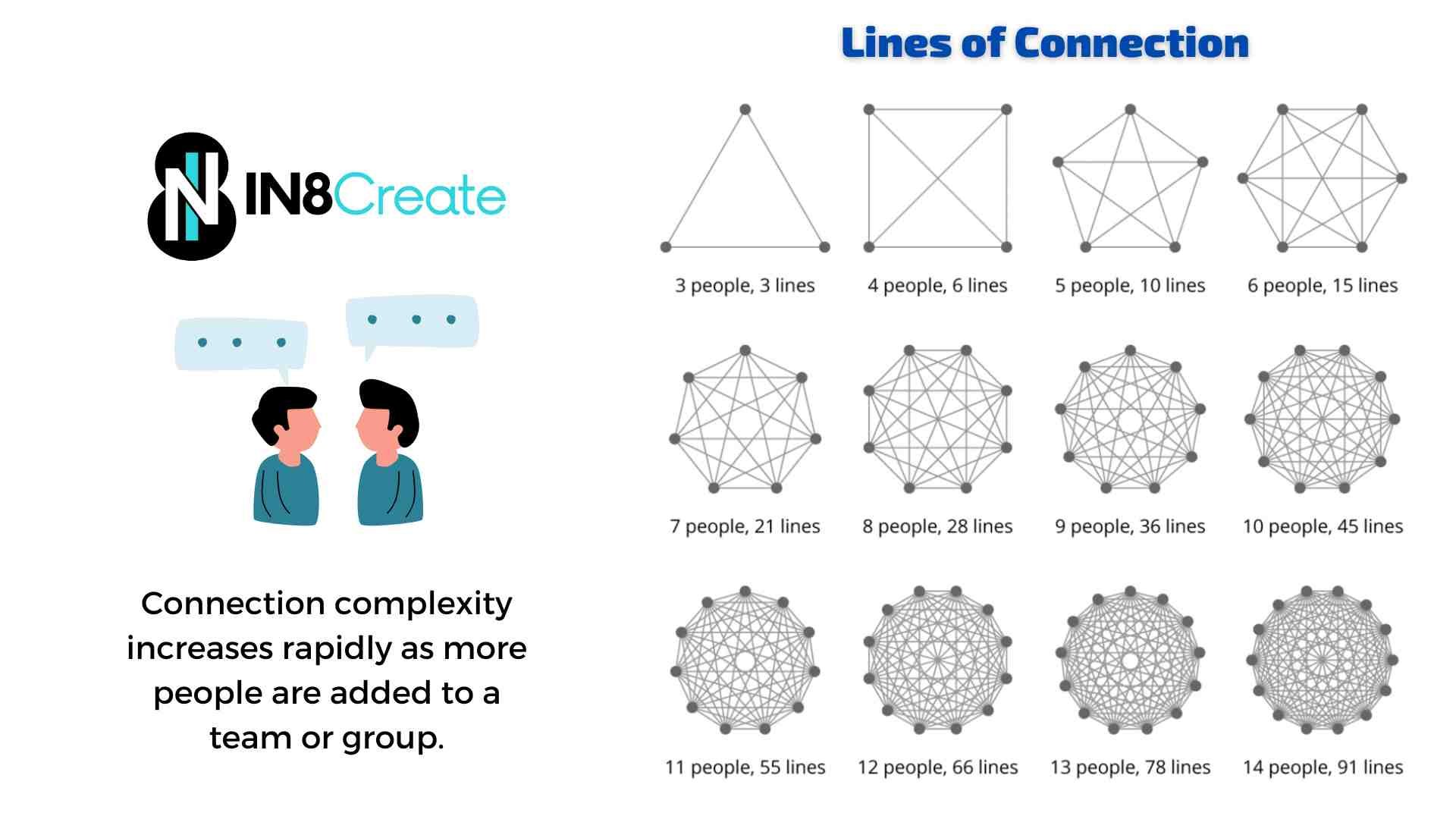
When it comes to team communication, things are often more complex than they appear. Just like adding an ingredient to soup changes every bite, adding a new person to a team changes every group interaction. This complexity scales quickly and can become challenging to manage without the right tools and strategies.
Exponential Connections
Consider this: a team of three people has three connections. Add a fourth person, and the number of connections jumps to six. With five people, there are now ten connections. Each new member brings a unique dynamic, forming new relationships with every existing member. This exponential growth in connections can make communication incredibly complex.
The Soup Analogy
Imagine making a pot of soup. With each new ingredient you add, the flavor profile of every spoonful changes. Similarly, when a new person joins a team, they influence every interaction, conversation, and relationship. This added complexity can enhance the team's performance or create challenges, depending on how well the communication is managed.
Understanding the Problem
Recognizing the complexity of team communication is the first step in addressing it. Each additional person adds more than just one more voice—they add multiple new relationships. Understanding this exponential growth is crucial for effective team management.
What This Actually Looks Like in Your Daily Work
You've probably experienced this complexity without realizing it was a system issue. Here are the warning signs your team communication has become too complex to manage effectively:
Decision confusion: You make clear decisions in meetings, but team members walk away with different understandings of what was decided
The silent experts: Your most knowledgeable team members stay quiet while less-informed voices dominate discussions
Repeated conversations: You find yourselves having the same discussions over and over because nothing actually gets resolved
Email overload: Simple questions spawn endless email chains because people can't align on basic concepts
Project drift: Work gradually veers away from original objectives because different team members are operating from different mental models
The Hidden Cost of Communication Overload
Your communication complexity isn't just a "people problem"—it's directly impacting your bottom line. When teams can't efficiently process information and align perspectives:
Projects take 40% longer than necessary due to rework and clarification cycles
Your best people burn out faster trying to decode what everyone else actually means
Critical insights never surface because your current communication structure doesn't give quieter voices a platform
Innovation stalls because breakthrough ideas get lost in the noise of inefficient group discussions
Why Traditional Communication Training Falls Short
You've probably tried communication workshops before. Most focus on teaching individual skills like "active listening" or "conflict resolution." But here's the problem: you're not dealing with individual communication deficits. You're dealing with system architecture that can't handle the complexity you've created.
Teaching someone to be a better communicator in a broken system is like teaching someone to drive faster on a road full of potholes. The real solution is fixing the road.
Building Solutions with LEGO-Based Sessions
Solving communication complexity requires a structured approach. That's where LEGO Serious Play (LSP) comes in. Our LSP sessions are designed to improve communication, collaboration, and connection within teams. By using LEGO bricks, we create a safe and engaging environment where everyone can express their ideas, ensuring that all voices are heard.
Equal Representation: Every team member builds and shares their model, promoting equal participation.
Psychological Safety: The playful nature of LEGO reduces barriers, encouraging open and honest communication.
Visual and Tactile Engagement: Building with LEGO helps participants articulate complex ideas more clearly.
What Actually Happens in Our Sessions (Real Client Results)
You might be wondering if this actually works with serious business professionals. Here's what we consistently see:
100% participation: Even your most reserved team members actively contribute because the building process gives them thinking time and a concrete way to express abstract ideas
Hidden insights surface: As one client put it, "I saw people open up in a new way" - perspectives that never emerged in traditional meetings become visible
Authentic dialogue: The physical models create shared reference points, so instead of debating abstract concepts, teams discuss specific, tangible representations of their ideas
Lasting impact: Teams report continued use of metaphors and concepts from sessions months later
One research team manager told us: "Brandon's workshop allowed us to get to reconnect with each other in a much deeper way than we could have accomplished by just talking for the whole day. Each of us felt very seen by the process."
The Science Behind Why This Works
Your brain processes information differently when you engage your hands. This isn't just theory—it's measurable neuroscience:
The hand-brain connection: Your hands contain more sensory receptors than almost any other part of your body. When you build with your hands, you're accessing different neural pathways than verbal communication alone
Externalization effect: When you build your thoughts into a physical model, you can examine and discuss ideas objectively rather than defensively
Reduced cognitive load: Physical models "hold" complex information, freeing up your mental capacity to think about relationships and implications rather than trying to remember details
Equal processing time: While verbal processors think out loud and dominate discussions, building gives internal processors the time they need to formulate and express their insights
Contact Us Today
Understanding the complexity of team communication is half the battle. Solving it is the other half. Let us help your team navigate these complexities with our LEGO-based sessions.
Your Next Step
You don't have to keep watching your team struggle with communication complexity. If you're ready to see what happens when every team member actually contributes their best thinking, here's what to do next:
Start with a diagnostic conversation: We'll help you identify exactly where your team's communication system is breaking down and what it's costing you in terms of time, money, and missed opportunities.
Experience the methodology firsthand: Your team will engage in a structured session where abstract challenges become tangible, discussable models.
Walk away with a new operating system: You'll have shared language, clearer mutual understanding, and proven methods for surfacing insights from every team member.
Related Posts:
Building Stronger Connections In Teams
