

Why "Don't Bring Me Problems" Trains Your Team to Go Silent
A well-meaning rule quietly turns signal into silence. Here's what to build instead.
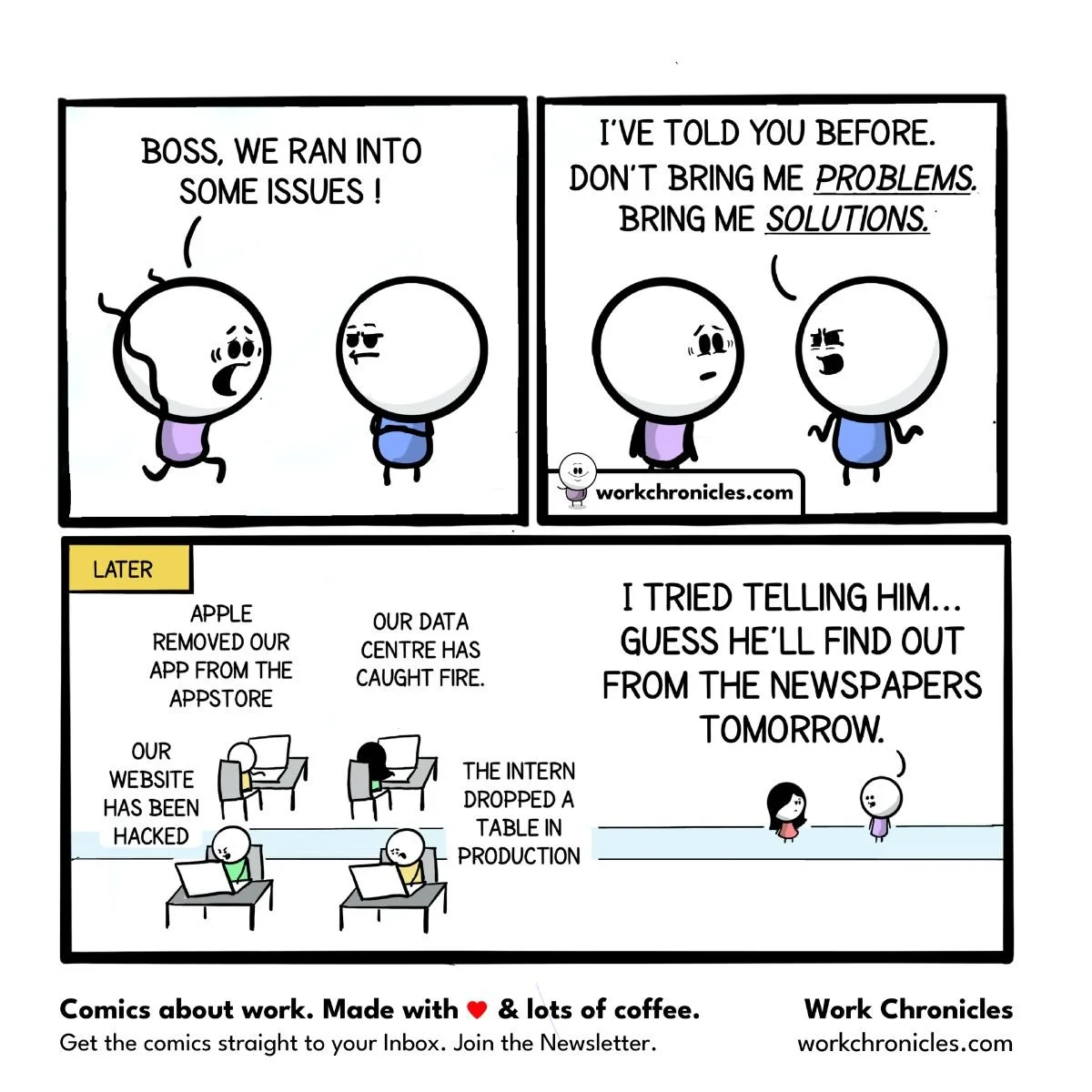
The rule sounds like discipline. What it actually builds is a team that stops warning you, right up until the problem is too big to hide.
You've heard it. Maybe you've said it. Maybe you're saying it right now and your team already stopped listening.
Here's why the line is seductive. It solves a real problem. Some teams bring you everything. Every paper cut, every hiccup, every "quick question" that eats twenty minutes. The rule shuts that off.
Silence, finally.
Except silence isn't the same as clarity.
A filter that's too loose drowns you. A filter that's too tight blinds you. And a right-sized one is brutally hard to build, because the line between "handle it" and "flag it" moves depending on who's holding the issue.
Most leaders treat that filter like a policy. Say the rule once, and the team calibrates. But a filter isn't a policy. It's a judgment your team makes hundreds of times a week, usually in the half second before they decide whether to knock on your door. And every one of those judgments runs through a system you mostly can't see.
The math is working against you before you do anything
Start with the hierarchy. Thirty to fifty percent of what's real drops at each level. Not because people are hiding it. Because every handoff is a summary, and summarizing is lossy by design. By the time something climbs three rungs, most of it is gone, and the part that survived is the part that was easiest to say.
Then there's the Mum Effect. Bad news moves up the slowest of all, because nobody wants to be the person carrying it. We are wired to soften it, delay it, or wait for someone else to go first.
And the decision to raise something difficult runs on asymmetric math. The person weighing it holds a cost that's certain, immediate, and personal (looking negative, being wrong, the awkward meeting) against a benefit that's diffuse, future, and shared. That equation almost always resolves the same way. Not worth it. So they hold it.
That's the drag before you've done a single thing.
Now add your own signals. The expectations you didn't know you set. The way you react when something lands badly. How you frame your asks, and what your last three reactions taught people about what's safe to bring you.
Then add the group. People read each other before they read the facts. Combine that social comparison with the stories a team tells itself to make sense of what's happening, mix in a little repetition and time, and you get a rut. That rut hardens into "how we actually work here," no matter what the handbook says. New hires learn it in a week, and it's rarely written down anywhere.
None of this is lying. It's architecture. The system is built to lose the signal before it ever reaches you, and the "bring me solutions" rule doesn't fix the architecture. It just turns the volume all the way down.
You can't build the filter alone
Stack all of that up and one thing gets obvious. You need intentional filters. You cannot build them by decree. And you cannot build them alone, because the edges of the puzzle look different from every seat at the table.
Here's the part that surprises people. The filter isn't really about information. It's about agreements. What counts as "handle it." What counts as "flag it." What we do when someone genuinely isn't sure which one they're looking at. When those agreements live only in your head, your team is guessing. When the team writes them together, out loud, the guessing stops.
That's the heart of the work I do around Core Constants. A team co-authors the handful of things it's going to actually operate by, then runs those constants against real work until they hold up or break. The filter for what reaches you is one of them. Not a rule you hand down. A constant the team owns, tests, and rewrites when reality proves it wrong.
The difference matters. A rule you impose gets followed until it's inconvenient. A constant the team authored gets defended, because it's theirs.
So the next time you hear yourself say "don't bring me problems, only solutions," be careful.
You might just get exactly what you asked for.
Want to start surfacing what your team isn't saying?
You don't need a program to begin. You need better questions.
I put together five of them. They're the questions that pull out what your team won't say in a meeting, a town hall, or a pulse survey. The kind of thing people only tell you when the question itself gives them permission. A pre-mortem that lets someone voice a fear as a prediction. A say-do question that names the gap without naming a person. Small moves that open a lot of ground.
Reach out and I'll send you the full list, free. No pitch attached.
