

Silence is Communication
What Your Team Hears When You Say Nothing
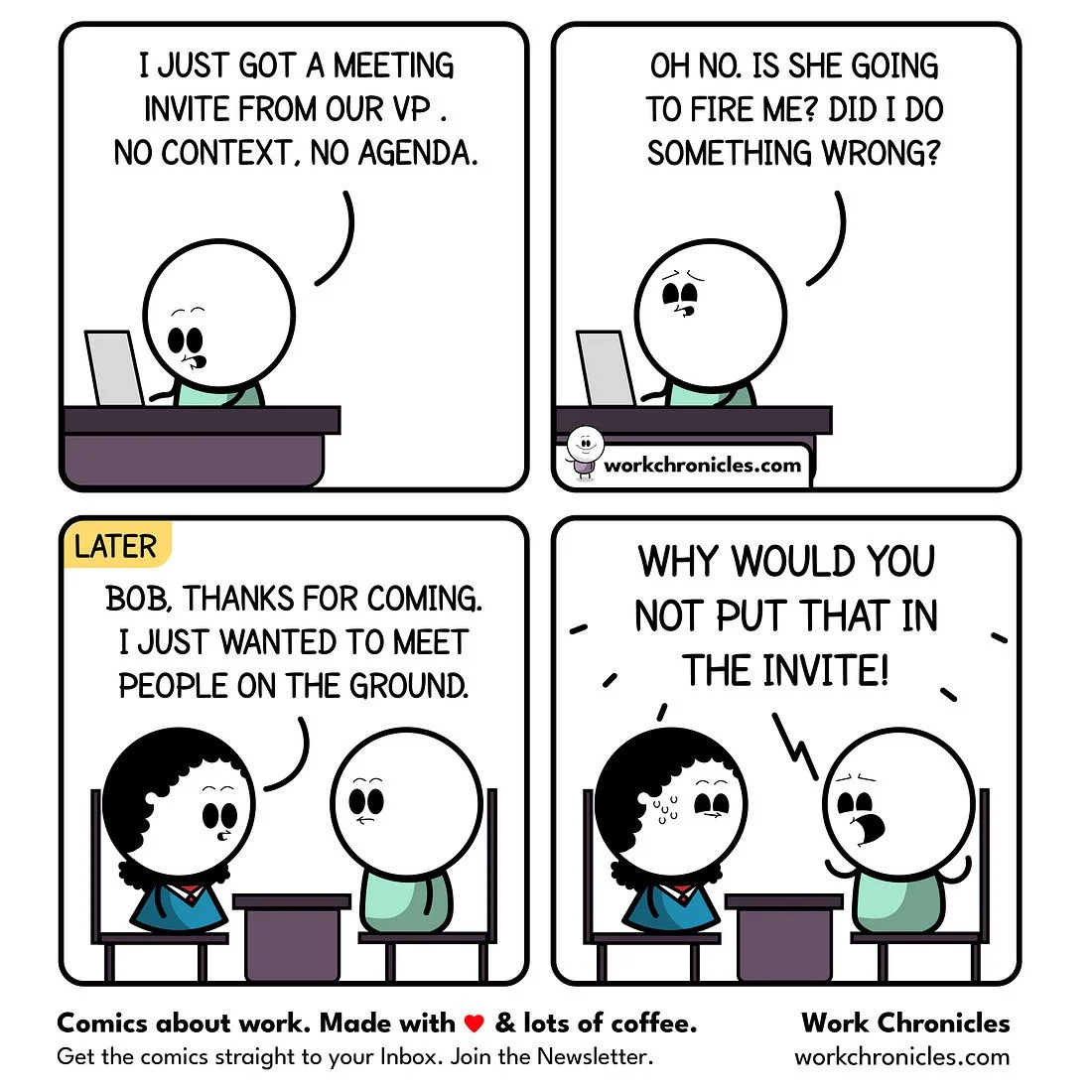
When information is missing, we fill in the blanks and assume the worst.
I remember it like it was yesterday. Middle of a town hall with the CEO, my phone vibrated with a meeting invite - my SVP and HR. No context. No agenda.
Instantly, I knew I was getting laid off.
When you know, it's like a danger alarm goes off in your mind. Income's gone. What will I do? Where will I go? How much severance? Who can I call to get the ball rolling? Should I move? Should I start my own business? Can I even do that?
And so on, and so on.
I've been on the receiving end of this kind of news three times. I figured out two of the three in advance.
People aren't dumb - they figure these things out. When there are blanks, we fill them in. And when you leave them empty, we assume the worst.
Why Is Silence a Form of Communication?
Silence communicates because humans are pattern-recognition machines. When information is missing, we fill in the blanks—and we almost always assume the worst.
The same happens with senior leaders who stay silent during tough times, during change, during transformation. If space is left empty, people will fill in the blanks.
Your silence isn't neutral. It's not a pause. It's not buying you time to figure things out. To your team, silence is a message - and rarely the message you intend to send. A leader's silence during uncertain times isn't neutral; teams interpret it as hiding bad news, lack of trust, or signal that they should update their resumes.
Why Does Uncertainty Trigger Such Strong Reactions?
There's a reason silence triggers such powerful reactions. David Rock's SCARF model identifies five domains that our brains constantly monitor for threats: Status, Certainty, Autonomy, Relatedness, and Fairness. When any of these are threatened, our brains shift into protection mode - the same fight-or-flight response that kept our ancestors alive.
Certainty is one of the most powerful drivers. Our brains are prediction machines, constantly trying to anticipate what's coming next. This ability to predict the future makes us feel safe and in control. When that certainty disappears - when leaders go silent during turbulent times - our brains perceive it as a threat.
The absence of information triggers the same neurological response as actual danger. Stress hormones flood our system. Productivity drops. Creativity shuts down. People become hypervigilant, reading into every email, every cancelled meeting, every closed-door conversation.
And here's the kicker: they're usually right to be worried. Their pattern recognition isn't paranoia - it's experience.
(For a deeper dive into the SCARF model and how it applies to team dynamics, check out Neuroscience and LEGO Serious Play with David Rock's SCARF Model.)
What Do Leaders Get Wrong About Communicating Uncertainty?
Most leaders stay silent during uncertain times because they think:
"I don't have all the answers yet"
"I don't want to worry people unnecessarily"
"Things are still evolving, I'll wait until there's something definitive to say"
"I'm protecting the team from the chaos"
But here's what your team actually hears when you go silent:
"They're hiding something bad from us"
"They don't trust us with the truth"
"We're not important enough to be kept informed"
"I should probably update my resume"
The irony is brutal: You stay silent to protect your team from worry. Your silence creates the very worry you were trying to prevent - multiplied by uncertainty and imagination.
How Should Leaders Communicate During Uncertainty?
The solution isn't to have all the answers. The solution is to communicate about the uncertainty itself.
Here's the framework that actually works:
1. Acknowledge That Uncertainty Exists
Don't pretend everything is fine when it obviously isn't. Name the elephant in the room.
"I know everyone's wondering what's happening with the restructure. I'm going to be straight with you about what I know and what I don't know."
This simple acknowledgment reduces threat response. You're not hiding anything, which means their pattern-matching alarms can stand down.
2. Share What You Know - Even If It's Incomplete
Tell them everything you can tell them, even if it feels insufficient.
"Here's what I know right now: We're combining two divisions. The leadership structure will be finalized by end of Q1. No decisions have been made yet about team composition."
Partial information is vastly better than no information. It gives people's brains something concrete to work with instead of spiraling into worst-case scenarios.
3. Be Explicit About What You Don't Know
Uncertainty is easier to handle when it's defined. Tell them what you don't know yet.
"What I don't know yet: exactly how many roles will be affected, what the new org chart looks like, or when we'll have final details. We're working through those questions now."
Defined uncertainty is manageable. Undefined uncertainty becomes whatever nightmare someone's imagination creates.
4. Explain How You're Looking at Information
Share your process. Let them see inside your decision-making.
"Here's how we're approaching this: We're analyzing workload distribution across both teams, mapping skill sets against future needs, and talking to team leads about who works best together. This is data-driven, not arbitrary."
Process transparency builds trust. Even if people don't like the outcome, they can respect a fair process.
5. Set Expectations for Future Communication
Tell them when you'll update them next - and keep that commitment.
"I'll update everyone next Tuesday at our team meeting, whether or not I have new information. And if anything major develops before then, I'll let you know immediately."
Regular updates create a rhythm of certainty even when the content is uncertain. Your team knows when they'll hear from you next, which reduces the anxiety of wondering when the other shoe will drop.
6. Tell Them What They Can Do
Give people agency. Nothing combats uncertainty like action.
"Here's what you can do: Keep documentation on your current projects and wins - it'll be helpful regardless of how things shake out. Focus on your work. And come to me directly with questions rather than relying on hallway speculation."
Action is the antidote to anxiety. When people have something concrete to do, they feel less helpless.
What Happens When Leaders Get This Wrong?
When leaders fail to communicate through uncertainty, the consequences compound:
Top talent leaves preemptively. Your best people have options. They don't wait around to see how bad it gets.
Productivity plummets. People spend more time gossiping and job hunting than working.
Trust evaporates. Once you've trained your team that silence means bad news, they'll never trust your silence again.
Culture corrodes. The hallway becomes more powerful than official communications. Rumors become truth.
I've watched transformations fail not because the strategy was wrong, but because leaders didn't realize their silence was killing it. The technical plan was sound. The communication plan was fatal.
Silence During Change is Leadership Malpractice
If you're leading through change - restructuring, M&A, strategic pivot, technology transformation - and you're staying silent because you don't have perfect information yet, you're actively sabotaging your own efforts.
Your team's brains are wired to assume the worst when faced with uncertainty. That's not a flaw in your team - that's neuroscience. The only question is whether you'll work with their brains or against them.
Communicate early. Communicate often. Communicate even when you don't have answers. Especially when you don't have answers.
Because when you say nothing, your team hears everything.
Looking to navigate major change with your team? Sometimes uncertainty needs more than communication - it needs structured dialogue where everyone can surface their real concerns. Let's talk about what that could look like for your team. We’re based in NYC!
